
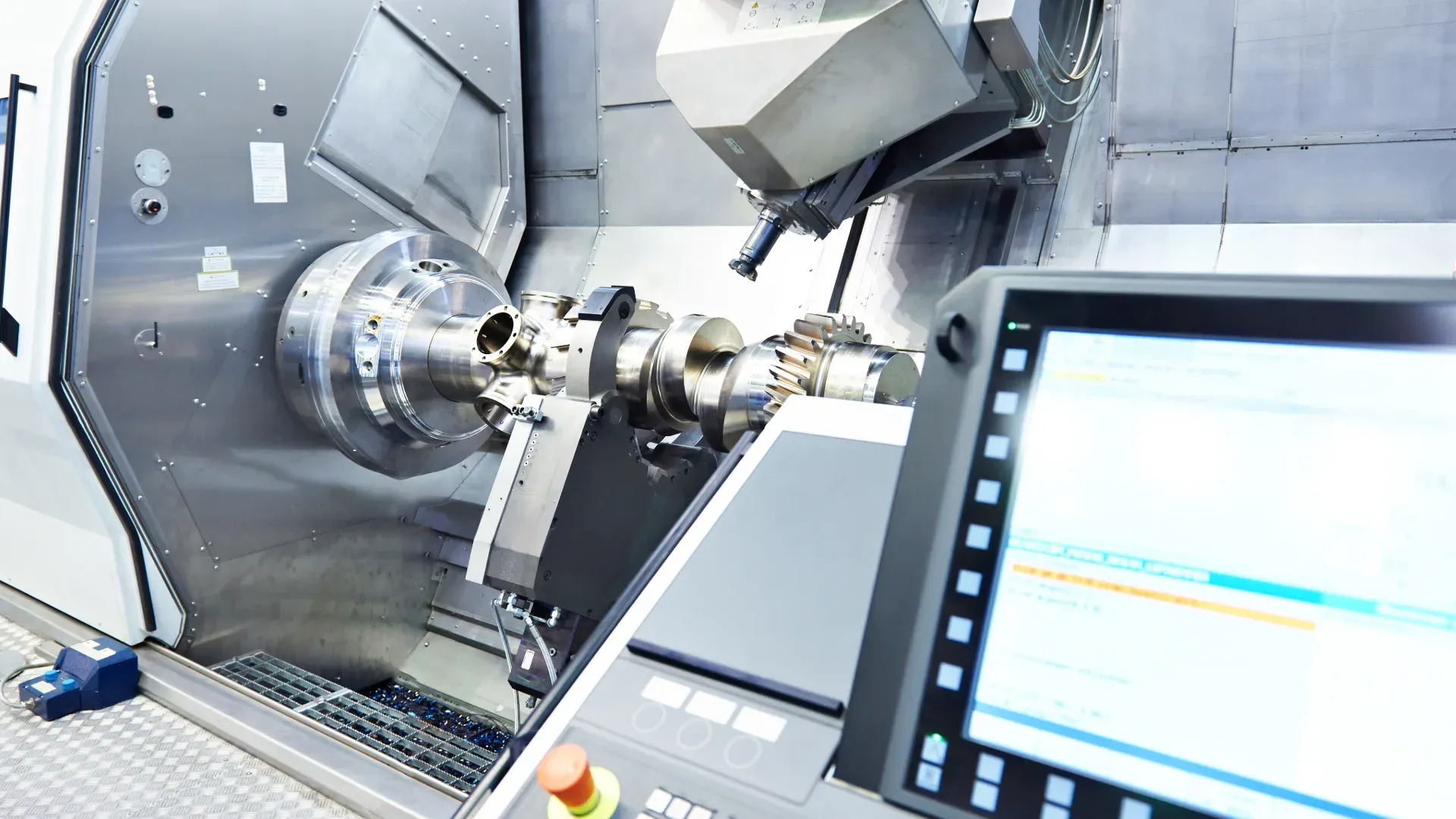
CNC parts are found in almost every machine. Shafts, flanges, housings, brackets and fixtures are often machined on a CNC machine. Anyone who buys or designs components comes across the term constantly. What it covers, which processes belong to it and when CNC is the better choice than other manufacturing methods is rarely clear at a glance.
This article is an overview for purchasing, design and anyone new to the topic. It explains how CNC manufacturing works, which processes exist, which materials are suitable and which parts are worth machining.
What does CNC mean?
CNC stands for “Computerized Numerical Control”. A CNC machine moves its tool along programmed paths made up of coordinates and commands. The program is usually generated from a 3D model of the design. A CNC programmer defines the tools, cutting parametres and the order of the machining steps. The machine then runs the program, as many times as needed with identical results.
CNC manufacturing usually means machining. Material is removed from a blank, for example a block, plate or bar, until the required shape is produced. Manufacturing standards group the cutting processes with a defined cutting edge, which include turning, drilling and milling, into one category. The counterpart is additive processes such as 3D printing, where a part is built up layer by layer, and primary shaping processes such as casting and injection moulding, where material is brought into a mold.
The main CNC processes at a glance
Different processes are used depending on the shape of the part. A single component often combines several of them.
| Process | Principle | Typical parts |
|---|---|---|
| Milling | The tool rotates and travels over the stationary workpiece | Housings, plates, brackets, shaped parts, pockets and slots |
| Turning | The workpiece rotates, the tool stays fixed and removes material | Shafts, bolts, bushings, sleeves, flanges |
| Drilling, countersinking, reaming | Producing and finishing holes | Bolt patterns, fitted holes, threaded holes |
| Grinding | Fine finishing with abrasives for very smooth, dimensionally accurate surfaces | Bearing seats, guideways, hardened parts |
| EDM (electrical discharge machining) | Material removal by spark erosion, only for electrically conductive materials | Hard materials, fine contours, tools |
| Mill-turn machining | Turning and milling in one setup on one machine | Complex parts with round and milled features |
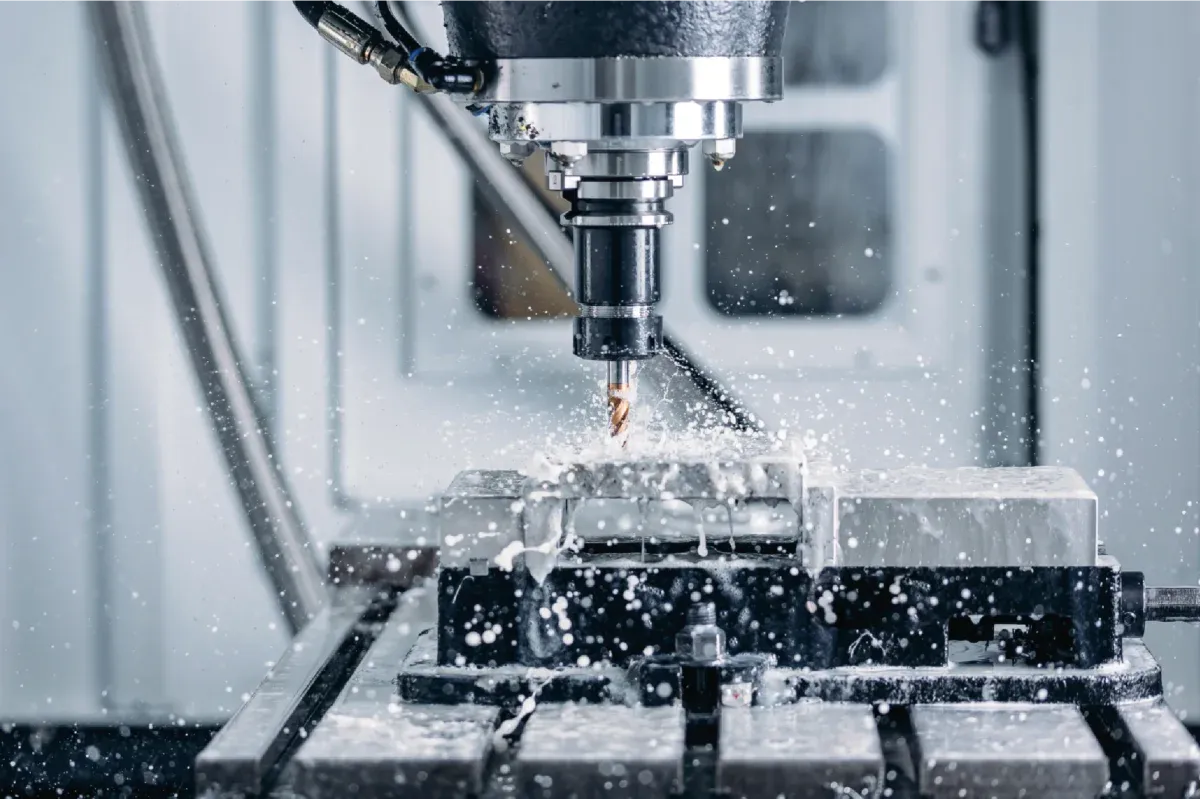
In CNC milling, a rotating tool removes material from the clamped workpiece, cooled and lubricated by coolant.
In turning, the workpiece rotates while a stationary tool removes material. This suits rotationally symmetric parts. In milling, the tool rotates and the workpiece stays clamped. This makes it possible to produce almost any contour, pocket or bolt pattern. Drilling, countersinking and reaming are separate processes but usually run on the same machines. Grinding is a finishing process and is used when dimensions and surfaces need to be tighter than milling or turning can deliver. EDM removes material with sparks. It works only on electrically conductive materials, is often time-consuming and can alter the surface layer of the material. In return, it can machine very hard materials.
In mill-turn centres, a part is turned and milled in one setup. This saves re-clamping and helps with parts that combine a round base shape with holes, flats or slots.
3-, 4- and 5-axis milling: how machines differ
A milling machine is classified by its number of axes. The more directions of movement it has, the more complex the parts that can be machined in one setup.
- 3-axis milling: The tool moves along the three linear axes X, Y and Z. If a part has to be machined from several sides, it must be re-clamped. For plates, simple housings and parts that are accessible from one side, this is the economical standard solution.
- 4-axis milling: An additional rotary axis turns the workpiece so that several sides can be reached without re-clamping.
- 5-axis milling: Two rotary axes are added to the three linear axes. In 3+2 milling, the workpiece is fixed in a tilted position and then machined in three axes. In simultaneous 5-axis milling, all axes move at the same time. This suits freeform surfaces, for example in aerospace, mold making or turbine parts.
Fewer setups mean shorter setup times and often better dimensional accuracy, because errors from re-clamping do not add up. On the other hand, 5-axis machines cost more. The rule of thumb is therefore to use only as many axes as the geometry requires.
Which materials are suitable for CNC
Mostly metals are milled and turned: aluminium alloys, steels, stainless steels, titanium, and copper and brass. They differ widely in machinability and price. Aluminium and steel are common and comparatively inexpensive. Titanium is considerably more expensive and harder to machine. The harder a material, the slower the machining and the greater the tool wear.
Plastics can also be machined, on the same machines that are used for metal. Typical choices are engineering plastics such as POM, PA or PEEK. High-performance plastics or filled grades can cost more as raw material than some metals. Plastics raise additional questions, such as thermal expansion and moisture absorption, which affect dimensional stability and tolerances.
When in doubt, choose the most common material that meets the requirements. This keeps cost and lead time down.
How accurate CNC parts are
CNC machining delivers tight tolerances and good surface finishes without the need to build a tool. The accuracy that can be achieved depends on the machine, the material, the part geometry and the machining strategy. For dimensions without an individually specified tolerance, a general tolerance applies, for example to BS EN 22768-1, which has four classes from fine to very coarse. Specify tighter tolerances only for function-critical dimensions, because they increase the effort for manufacturing and measurement.
How to request documentation on dimensions, material and first article samples is explained in our article on quality documentation for CNC parts.
When CNC manufacturing pays off
CNC is strongest for single parts, prototypes and small to medium-sized series. It needs no shaping tool, setup is manageable and design changes can be implemented quickly. The parts have the properties of solid material and can be made to tight tolerances. Typical applications:
- Prototypes and sample parts: Functional samples in a near-series material that change during development.
- Fixtures and production equipment: Holders, gauges and assembly aids in small numbers.
- Spare parts: Shafts, bushings, flanges or housings when the original manufacturer no longer supplies them.
- Precision parts: Mating surfaces, bearing seats and sealing surfaces with tight tolerances.
- Small series: Quantities for which a casting or injection mold does not yet pay off.
CNC reaches its limits where the geometry is not accessible. Internal channels, lattice structures and undercuts are hard to reach with milling cutters and turning tools. At very high volumes, the large amount of material removed per part becomes a cost factor, and casting or injection moulding is often cheaper.
CNC compared with 3D printing, casting and injection moulding
Which process fits depends on geometry, quantity, material and tolerances. The following table gives a rough classification.
| Process | Tooling cost | Suited for | Limits |
|---|---|---|---|
| CNC machining | none | Single parts to medium quantities, tight tolerances, solid material | Accessibility of the geometry, material removal |
| 3D printing | none | Complex geometries, prototypes, very small series | Surface and tolerances often need finishing |
| Injection moulding | high (mold) | High volumes in plastic | A mold only pays off above a certain quantity |
| Casting | medium to high (mold or pattern) | Larger metal parts in series, blanks | Functional surfaces need finishing |
In practice, manufacturers often combine the processes. A cast part gets its mating surfaces by CNC machining, and a 3D-printed part is milled at the interfaces. A detailed comparison is in our article CNC machining vs. additive manufacturing. The break-even point of tooling depends on the part and the quantity, and we are happy to assess it for your case. You can find more on the processes on our pages for casting, injection moulding and 3D printing.
Not sure which process suits your part?
Send us your drawing or CAD model, and we will check manufacturability and recommend the right process.
How a CNC order works
The path from requirement to finished part is similar at most manufacturers:
- Inquiry: You send a 3D model (for example as a STEP file) and a drawing with tolerances, material, surface finish and quantity.
- Manufacturability check: The manufacturer checks whether and how the part can be made and gives design feedback if needed.
- Quotation: Price, lead time and the scope of inspection and documentation.
- Programming and setup: The manufacturer creates the CNC program, selects the tools and clamps the blank.
- Production and inspection: The part is machined, then inspected and documented as agreed.
- Finishing and delivery: Deburring, surface treatment, packaging and shipping.
The more complete the documents in step 1, the faster and more reliable the quotation. This includes following design rules from the start: sufficiently large inside radii, walls that are not too thin, standard threads and tight tolerances only where they are functionally necessary.
Sourcing CNC parts through Replique
Replique makes CNC parts through a network of 450+ certified partners worldwide. We check your data, select the right manufacturing partner, manage production and control quality, so you have one point of contact instead of many suppliers. You can find more on our pages for CNC machining on demand and our supplier network. How to find a suitable manufacturer is described in our article on finding manufacturing suppliers.
Planning a CNC part and want to clarify the next step?
We advise you on process, material and tolerances and come back to you with a quote.
FAQ
Basics
What does CNC mean?
CNC stands for “Computerized Numerical Control”. A CNC machine runs a program that defines the movements of the tool. The term usually refers to machining, where material is removed from a blank.
What is the difference between CNC milling and CNC turning?
In turning, the workpiece rotates. In milling, the tool rotates. Rotationally symmetric parts such as shafts and bushings are turned. Housings, plates and parts with pockets and bolt patterns are milled. Many components need both and are made on mill-turn machines.
Processes and materials
Which materials can be machined with CNC?
Mainly metals such as aluminium, steel, stainless steel, titanium, copper and brass, as well as engineering plastics such as POM, PA or PEEK. How well a material machines affects machining time, tool wear and price.
What is 5-axis milling used for?
For complex parts with freeform surfaces or many sides that are to be machined in one setup. This saves re-clamping and can improve dimensional accuracy. For simple parts, 3-axis milling is usually enough and costs less.
Cost-effectiveness
From what quantity does CNC pay off?
There is no fixed limit. CNC needs no mold, which makes it particularly suitable for single parts, prototypes and small series. At very high volumes, casting or injection moulding is often cheaper. Where the break-even point lies depends on geometry, material and tolerances.
CNC or 3D printing: which is better?
That depends on the part. CNC is strong for simple geometries, tight tolerances and solid-material properties. 3D printing suits complex shapes with internal channels and small quantities. The two often complement each other, for example when a printed part is milled at the interfaces.
What documents do I need for a CNC inquiry?
As a rule, a 3D model (for example as a STEP file) and a drawing with tolerances, material, surface finish and quantity. If information is missing, the manufacturer will ask.